Lately
I've been noticing it for a while. More and more people put up a PR and can't explain it when I ask what it does. More and more production alerts come through. And the pressure to ship is greater than I've ever known it.
Then I read about Meta, and it was the same thing at a scale nobody could explain away.
Project OT
In January Meta's leadership drew up a plan to hand much of the work of thousands of employees to AI, with scenarios that cut some teams by as much as 60% [1]. The first wave of layoffs took a tenth of the company in May. Hours before it went out, Zuckerberg called off the second wave [1].
Reuters couldn't say exactly why. It did report what the AI had produced. By June, code changes to Meta's internal platforms were up 220% on the year and features reaching users were up 36%. Infrastructure teams had been warning since March that the surge in AI-written code was hurting reliability, and serious incidents were up 40%, with 70% more time spent firefighting them [1]. Bosworth, Meta's CTO, told staff that "token usage alone is not a measure of impact of any kind" [2]. Neither is a count of code changes.
More code than anyone could read, and more things on fire. That's my last few months with a much bigger budget.
Typing
Between reassignments and layoffs, some of Meta's engineering units were down as much as 30% by the end of May [1]. I use AI every day and it makes me faster at plenty of things. But nobody was ever paying an engineer to type. They were paying for someone who knows what should exist, reads what comes back and notices when it's wrong. An agent will write code all day. It can't tell you the code shouldn't exist, and it can't tell you it's wrong, because if it knew it wouldn't have written it.
The worse problem is that the people doing the work can't always tell either. METR ran a trial with experienced open source developers, randomly giving them AI on some tasks and not others [3]. They expected it to make them 24% faster. It made them 19% slower, and afterwards they still believed it had made them 20% faster [3]. That was early-2025 tools, and METR has since said the results no longer reflect where AI is now [3]. Even so, the developers in that trial couldn't feel the difference between activity and progress, and a headcount spreadsheet has even less chance.
Dead weight
Every organisation carries dead weight, and it's in every role. Some developers, some testers, some managers, and usually a director or two whose job nobody can describe. AI didn't cause that and it won't find it for you. Cutting a team by 60% removes 60% of it, dead weight or not.
AI doesn't change the right size of a team either. The Scrum Guide put a team at ten or fewer long before anyone had a coding agent, because smaller teams communicate better [4]. The arithmetic is old. Ten people have 45 lines of communication between them and five have ten, and every person you add costs everyone else some attention. That doesn't stop at the edge of the team. Every manager above it brings lines of their own, and so does every layer above them.
It makes me wonder whether Scrum itself matters much any more. A lot of what went into an estimate was the boring part, the wiring, the DTOs, the forms, the tests for the obvious cases. That's exactly the stuff AI is quickest at. The part left over is working out what to build and why it broke, and nobody has ever estimated that well. If the boilerplate is close to free, I'm not sure what a story point is measuring now. I don't have a clean answer. I'd still rather a team spent its planning time agreeing what good looks like than arguing over whether something is a three or a five.
Dave
There's a meme that keeps doing the rounds.
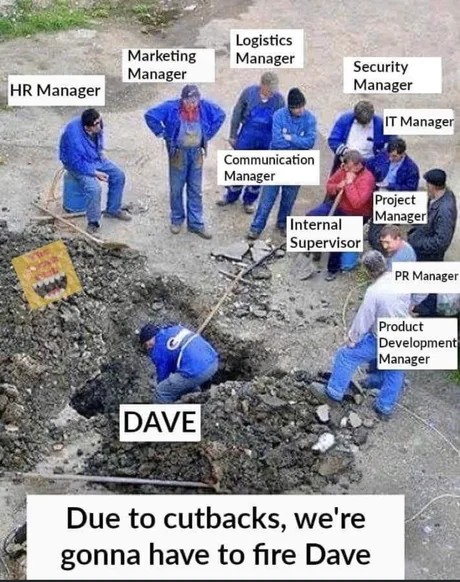
It feels more real now than it ever has.
Management decides who goes. The dimmest version of that conversation jumps straight from "AI can write code" to "we don't need developers", because everyone having it is standing round the hole.
The war room
I was in a marketing and commercial war room about subscriptions being down, and the room was panicking. The only things anyone was interested in were things you could do in Excel or by email. Nobody cared what the data actually said, or wanted to look outward at a changing world and ask why the product had got less attractive when they were doing nothing to make it better. They wanted more emails and a lot of busy work.
No amount of new ideas or out-of-the-box thinking mattered. Someone quite high up replied, sarcastically, "yes, we know you like data and AI", as if I was the problem.
Dinosaurs like that are the ones who should be cut in this new age.
Managers on managers
If AI can take headcount out of anywhere, it's from the edge of the hole. A lot of what a middle layer does is move information around. Status updates, roll-ups, the summary of the summary, the deck about the report. Summarising is the thing these tools are best at, and a wrong status update costs a lot less than a wrong database migration. Management layers could be lighter now than they have ever been.
You don't need managers on managers. You need clear expectations and a vision. A small team that knows what it's building and what good looks like needs one person to set the direction and clear the way, and not much else. Every layer stacked above that adds more lines of communication, another status report and another person retelling the vision slightly differently to the layer below.
To its credit, Meta's own internal playbook said so. Layers of middle management were to go, and Zuckerberg told his executives to push the changes through [1]. Most companies don't have a founder at the top willing to do that. Their list gets written by the people standing round the hole, and Dave keeps ending up on it.
Vision
A team needs people with vision, drive and the ability to wield AI. Someone has to know what's worth building before an agent builds it, keep pushing when the first answer is wrong, and read what comes back well enough to bin the plausible stuff that doesn't work.
That last part is a skill, and it's the one most at risk. Anthropic, who sell these tools, found that engineers who leaned on AI while learning a new library understood it noticeably worse afterwards, and debugging was where the gap was widest [5]. You build the ability to wield AI by understanding code. Hand that understanding over and you lose the thing that made the tool safe to use.
A warning
If you run a company and you're looking at Meta thinking AI can do your developers' jobs, don't. AI doesn't replace developer headcount. It makes good developers faster and lets everyone else produce more code nobody understands, and you'll find out which you've got from your incident numbers. Meta could afford to find out. You probably can't.
Any organisation without a clear vision and a thin management layer won't survive what's coming. Before anyone fires Dave, maybe the people holding the list should be honest and put their own names on it for a change.
Sources
- Mark Zuckerberg had a bold plan to replace Meta staff with AI. Here's how it imploded (Reuters)
- Meta minimizes role of token maxing in employee evaluations (InfoWorld)
- Measuring the Impact of Early-2025 AI on Experienced Open-Source Developer Productivity (METR)
- The 2020 Scrum Guide
- How AI assistance impacts the formation of coding skills (Anthropic)