Three copies of one schema
The other day a team I work with wrote the same Snowplow schema three times. They own several vendor integrations, each one its own domain in the platform, and they needed a schema for a new data structure. One copy per vendor, identical apart from the namespace, all inside their own silo.
The structure wasn't even theirs to silo. Every team in the company was going to need it, we have a central place for shared schemas, and moving it there was one pull request.
I pointed this out and expected a shrug and a ticket. Instead I got three hours of rage. "You're blocking our release." Managers pulled in left, right and centre, each one arriving pre-briefed that I was the problem. Nobody argued that three copies of one schema was good engineering, because there is no such argument. The argument was that I'd said it out loud near a release. Upholding the bar and blocking the release are the same action, and which one it gets called depends on who briefs the manager first.
I came out of it angrier than any production incident has ever made me. An incident is honest. Something broke, you find it, you fix it. This was three hours of being made the villain for saying the word once.
None of this is aimed at the team. They were following orders, handed down from people who care about speed more than quality. The irony is that the right way was also the fast way. Moving the schema was one pull request, and defending the copies cost three hours.
Somewhere in hour two I caught myself thinking, fine. Keep all three. Keep ten. Ship whatever you like, as long as somebody starts paying me for the aggravation.
And in the middle of it, someone asked me why one schema is better than three. "It's maintainable," I said, "and reusable across the org." It sounded thin over the noise. Maintainable according to whom? Who am I to decide what good looks like?
No community, no standard
Good, in engineering, was never one person's call. It belongs to a community, in its style guides, its review conventions, the patterns it has stopped arguing about. In a company with a working engineering community I wouldn't have needed to win that argument myself. The standard would have won it for me.
We don't have one of those. Where there's no community, good turns into taste. "Maintainable" and "reusable" become my preference against theirs, and that's how a one-pull-request fix turns into three hours of escalation. Nobody was arguing about the schema. They were arguing about whose taste wins.
The machine doesn't care
AI is handing a stronger version of "says who" to every coaster in the industry. Snowflake will hold three copies of that schema, or three thousand columns, and function perfectly well. No human can hold three thousand columns in their head, and an AI will do a convincing impression of doing exactly that. Timon made the pitch in the Lion King remake when he swapped the circle of life for "a meaningless line of indifference", where nothing connects so nothing you do matters. The engineering version is that the machine copes with six copies, so stop blocking the PR, the model will read the mess.
But good was never for the machine. The compiler doesn't care what we name things and never has. Our standards exist to fit systems inside a human head, because a human head is what turns up when it breaks at 2am. "Do it once, correctly" means sized for the people who have to carry it. That only stops mattering on the day no human needs to understand the system again, and if that day comes, we won't be able to tell, because telling would take the understanding we handed to the machine. The film gives Timon the line so it can spend its runtime proving him wrong.
The mediocrity tax
When good has no community behind it, somebody ends up holding the line alone, unpaid, one argument at a time. Call what that costs the mediocrity tax, the hours a strong engineer spends making other people's work safe to ship.
- The argument. Defending a position nobody disputes on the merits, while your name gets attached to the delay.
- The review that becomes a rewrite, because a fourth round-trip costs more than doing it yourself.
- The 2am incident in code you flagged, which you fix because you can and the author can't.
- Being the safety net planning assumes. Work is scheduled as if it arrives done, because someone catches it. You are someone.
The argument is the expensive one. A rewrite costs an evening. An argument about settled engineering costs the will to have the next one.
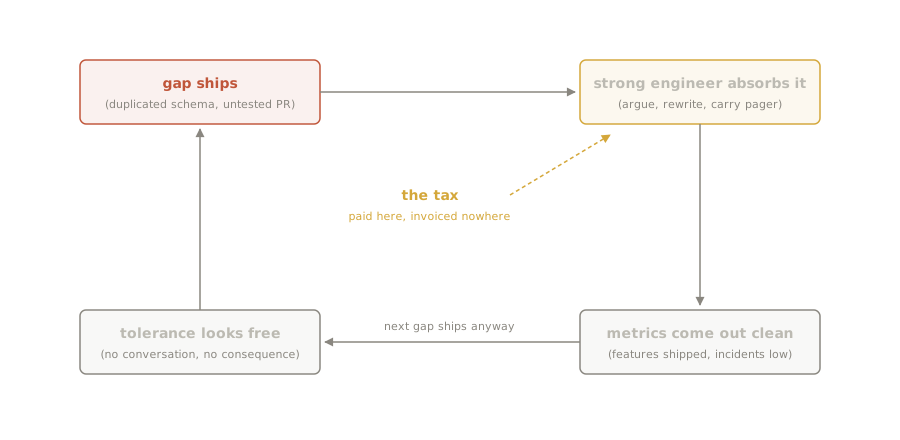
To be clear about who I mean, because mediocre gets thrown at people who don't deserve it. Juniors don't, because junior mistakes are the system working, and I'd do that reviewing for free. Neither do people at their ceiling, because average output at full effort was never the problem. Honest disagreement doesn't either, since arguing design on the merits is the job. The tax comes from experienced people who've noticed that the gap between their effort and an acceptable standard gets closed by someone else, free, and have decided to let it. Mediocrity, as I mean it, is a decision about how much of the job someone else can be made to carry.
And the part that makes me angriest is that coasting works. If someone else always closes the gap and the payslip looks the same either way, doing the job properly is effort the organisation has decided not to pay for. The coaster read those incentives correctly. I'm the one working against them for free.
What it costs
The research is blunt. One consistent low contributor drags team performance down 30 to 40 per cent, and teams sink towards their worst member rather than rise towards their best [1]. A Harvard paper covering 58,000 workers found avoiding one toxic worker is worth about $12,500, more than double the value of hiring a top-one-per-cent superstar [2]. Organisations still pour money into hiring pipelines and give the other problem a development-plan template.
None of it shows in the accounts. The team's tracking shipped, and nothing records the afternoon of escalation or the handholding after it. I won that argument and the ledger shows nothing. Lose it and the ledger shows the same nothing, until three drifting copies break a downstream join and the incident review blames the join. Raise any of this and you get a reputation. Strong engineer, bit spiky, needs to work on empathy. Meanwhile the reward for absorbing drag is more drag, because managers route fragile work to people who won't drop it. HR calls it performance punishment [3].
The end state is the Dead Sea effect [4], where the most capable engineers are the most able to leave and the least willing to keep paying, so they evaporate and what remains is whatever couldn't move. After one high performer quits, quit rates among the rest rise about six per cent a month for a quarter [5]. They weren't chasing money. The person who understood why they were tired had left.
The wrong fix
The executive answer is a cull, and culls have their own body count. When Vanity Fair interviewed staff about Microsoft's lost decade, all of them called stack ranking its most destructive process [6]. Grade people on a curve and they stop fighting the problem and start fighting each other. And it hits the wrong target. Fire the coaster, keep the incentives, and the seat refills with the same decision under a different name.
Price it
Two honest options.
Manage it. Feedback with consequences, in plain words, long before a release is on the line. I got lucky here, because my engineering manager backed the bar over the shortcut. One sentence, shared structures go in the shared place, said with authority, and the fight was over. Most organisations never say the sentence, so the tolerance gets called kindness, and it is, to one side, funded by the other.
Even then the tax didn't get refunded. The schema moved, and I still had to handhold the team through doing it properly, out of the mess they'd fought to keep. Backing from above stops the tax stacking up. The dragging is still yours.
Or pay it. If defending good is never going to be the company's job, it's somebody's work, and work goes on payslips. Pay the people who absorb the drag, out loud, as a line item. A premium for the person whose calendar is a map of other people's gaps is the invoice landing on the right desk for the first time.
That's the hour-two thought again. Do what you like, as long as somebody pays me to put up with the shit. As engineering it's surrender. As economics it's the most honest job description produced all quarter. Putting up with it is the work, and the market rate is not zero.
Most organisations pick the third option. Same band, same title, tax collected in silence, and a leaving do every eighteen months for someone the card calls irreplaceable.
To finish
Good still means something, which is that a human can hold it. The mediocrity tax is what defending that costs when nobody defends it with you. Price it, or watch the definition leave with the people paying it.
Sources
- Felps, Mitchell & Byington, "How, When, and Why Bad Apples Spoil the Barrel" (2006)
- Housman & Minor, "Toxic Workers", Harvard Business School working paper 16-057
- People Management, "Performance punishment: why increasing the workload of your high achievers is driving burnout"
- Bruce F. Webster, "The Wetware Crisis: the Dead Sea effect"
- LSE Business Review, "When a high performer leaves, the firm loses more than a good worker"
- Vanity Fair, "Microsoft's Lost Decade"