Northumberland
I'm camping in Northumberland, which is farm country, in a field ringed by other fields, and for days now I've watched the tractors. They start early. One goes up and down towing a sprayer, the next one over drags a cultivator, boom out wide, doing the thing tractors have done since the boom sprayer was invented. From a distance the passes look dead straight. Get closer and they aren't. There's a wiggle in them, and you can read it in the growing crop, a faint overlap here where he doubled back, a pale stripe there a boom-width wide that didn't get sprayed at all. It looks straight on the whole. It isn't perfect. And it takes all morning, and then the afternoon, and the next day the same tractors are back doing the same fields, and the day after that, and the day after that. There is a relentlessness to it I hadn't appreciated from a cursory glance out of a car window at seventy. The field doesn't get finished. It just comes round again.
My robot vacuum maps my house with a spinning lidar and remembers where the table legs are. It cost two hundred quid. I sat in a camping chair with a coffee, watching a man do his fourth straight day of laps, and thought that I could automate this entire field, and the man, and the tractor, and that I have no business thinking it because I have never grown anything in my life. Half a dozen veg in the garden each summer, which is not the same thing and we both know it.
So this is the daydream of someone who has watched too many systems work and not enough crops fail. If I bought a farm, would I farm it, or would I build it.
Elapsed time is not my time
The obvious objection to a spraying drone is capacity. A tractor's tank holds, what, one or two thousand litres? I'm guessing, but it's a lot. A drone holds a fraction of that, a few times more if it's a big agricultural one, and either way nowhere near. You'd spend the whole day landing to refill. Case closed, the tractor wins.
Except that's the wrong axis. The tractor's constraint isn't the tank, it's the man in the seat. He has to be there for every litre of it. The drone's constraint is the tank, and the tank is a problem of elapsed time, not my time. I don't care if it takes the drone all night and a stack of refills to do what the tractor does in a morning, as long as I'm asleep for all of it. A swarm of small drones working a field through the calm before dawn, returning to a charging-and-refill pad between passes, costs me nothing but the wait. The field doesn't know it's three in the morning.
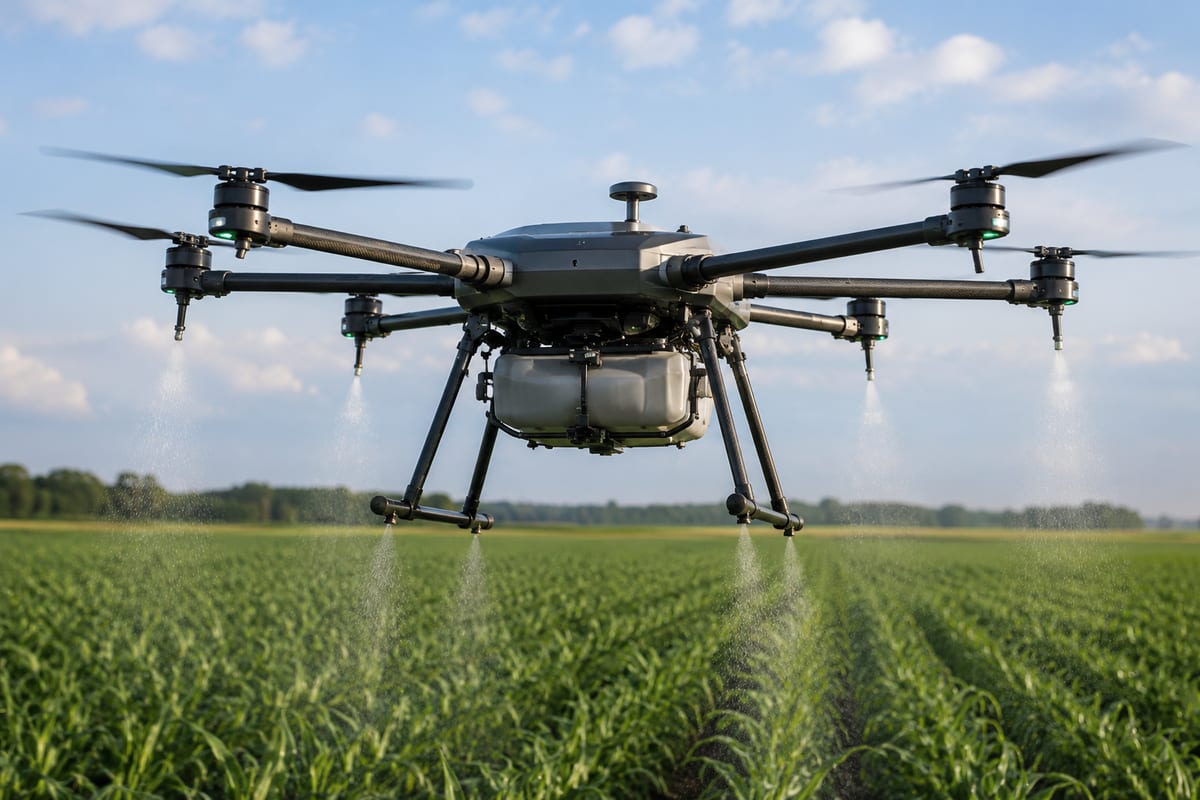
That reframe is the whole article, really. Almost every "the robot can't do as much per trip" objection dissolves the moment you stop counting trips and start counting the hours a human has to be present. Batch throughput is cheap. Human attention is the thing you're actually short of.
What the tractor was for
Strip the tractor back to what it actually is, a way to drag a heavy implement across soil while keeping a person near the implement to make decisions. The dragging is a solved problem. The person is the expensive part.
So picture the thing that replaces it. Not a driverless tractor, which is just the same machine with the man swapped for a worse man. A low, wide, slow crawler that lives in the field. It cultivates as it goes, and because it's moving at walking pace with sensors an inch off the dirt instead of a man at five miles an hour looking through glass, it can actually read the soil. Moisture, compaction, organic matter, a rolling map of where this field is healthy and where it's tired. Put a model on it good enough to reason about what it's seeing, and it stops being a cultivator and becomes a thing that notices the north corner is waterlogged again and files that the drainage there has failed two seasons running.
When it finds a patch that needs spraying, it doesn't drive back to a shed and tell a human. It orders a drone. The field becomes a system that schedules its own work.
And it doesn't have to be spraying. It finds a weed, it drops a pin on it. GPS is good to a few centimetres now, so "a weed" isn't a vague region of the field, it's a coordinate. A drone flies to the coordinate, a little grabber arm rips the weed out, drops it on the green-waste pile, and moves to the next pin. Same loop for a pest it can see. Spot it, pin it, send something to deal with it. The chemicals stop being the first move and become the fallback for the things too small or too many to pull by hand.
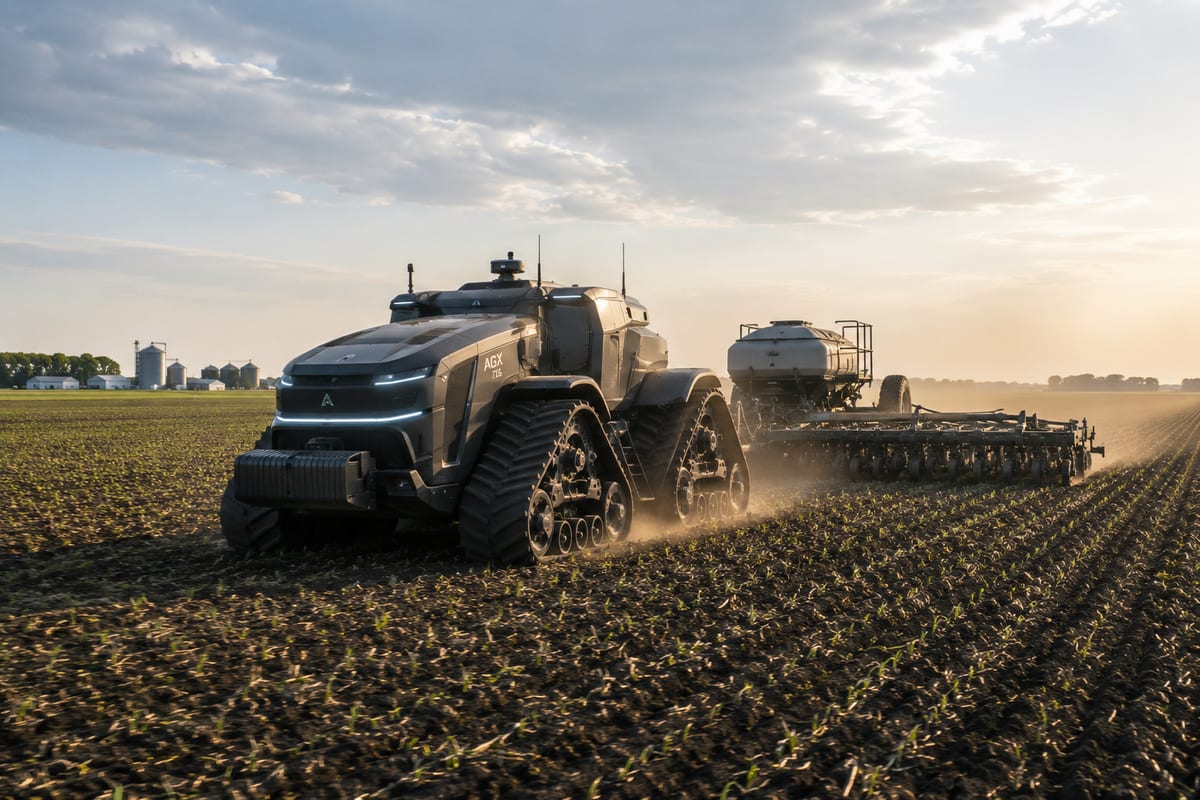
At which point the tractor is functionally dead. Not because it stopped working. Because the reason it existed, putting a person near the dirt, got solved by putting sensors near the dirt instead.
Planting against intuition
Here's one I can't actually answer, which is the point. If the crawler is building a soil-quality map as it goes, the planter that follows it can vary seeding density per square metre. The intuitive move is to plant densely where the soil is rich and thin it out where the soil is poor, because that's where the plants will struggle.
But you could argue the exact opposite. Plant densely in the poor soil, because each plant yields little and you're making it up on volume, and plant lightly in the good soil, because there you give each plant room to express its full yield without competing. Or the first version is right and the second one bankrupts me by the second harvest. I do not know.
A real farmer knows. He knows it the way I know which of our services will fall over under load, in his body, from having been wrong about it before. I would be a man with a beautiful per-square-metre soil map and a planting strategy generated by a model that has read about agronomy and never lost a crop. The map is real. The confidence is borrowed.
The fun ones
Once you accept that the farm is a system with an event loop, the ideas get cheap and slightly unhinged.
Machine vision in the grain silos, watching for rodents, with a low-power laser to deal with them. It's pest control as a securitypolicyviolation handler, where something that shouldn't be there trips the detector and gets dealt with at the edge. A small trash drone follows up and clears what the laser left, because a system that creates a mess and doesn't clean up after itself is just a different kind of infestation.
GPS collars on the livestock, not to find them but to learn their movement as a baseline. A herd has a shape to its day. The cow that stops tracking with that shape, that drifts and stands still while the others move to water, isn't lost. She's sick, or calving, and she's told you twelve hours before a human leaning on a gate would have noticed.
Automatic weigh-scales at the water trough, logging each animal off its ear tag every time it drinks. You don't care about the weight. You care about the first derivative. A daily drop, three days running, on one animal, is an alert worth more than any single number the scale ever produces. Disease is a trend before it's a symptom.
And then the ones I'd build at two in the morning and regret. Version-controlled soil, so I can diff this field against itself a year ago and see exactly what the nitrogen did. Pollination drones for the season the bees don't show, which is a sentence I hate having written.
Per plant, not per field
Bulk farming averages. You fertilise the field, you irrigate the field, you spray the field, because you cannot afford to know which individual plant needs what. The unit of decision is the whole field, so the whole field gets the same dose, calibrated to a plant that doesn't exist, the average one.
Hydroponics is the opposite philosophy. Every plant is a monitored unit, its nutrients and water and light dialled to it specifically. The only reason we don't farm open fields that way is attention. You cannot pay a human to inspect ten thousand plants a day, every day, so you treat them as a crowd and accept the waste.
A drone with machine vision doesn't get tired of looking. It flies the field low and slow and gives every plant a diagnosis off its leaves. Nitrogen-deficient on this row, water-stressed in the dry corner, the silver early-blight sheen on these four and not their neighbours. Then the treatment goes per plant. Spot-spray the four. Drip the thirsty one. Leave the healthy ones untouched and unsprayed. The chemical load and the water draw collapse, because you stopped dosing the average and started dosing the actual.
That's hydroponic-grade attention without the greenhouse, brought to open dirt by solving the only thing that was ever really scarce, someone to look at every single plant. The field stops being a field. It becomes ten thousand plants that each got looked at, which is a thing no farm in history has been able to afford and a drone does for the price of a battery charge.
The thing that actually dies
Every one of those replaces something a farmer used to know. The man in the tractor could look at his crop and tell you it was three days off being ready, and he could not tell you how he knew, because the knowing had soaked into him over thirty seasons of being right and wrong about that exact field.
My drone would beat him on the number. It would land on a plant, probe it, and read out the exact sugar content, or whatever the real ripeness marker is, I don't know. To a decimal place, on a thousand plants, in an afternoon. And that sounds like the upgrade until you see it's a different thing entirely. He has a judgement and the drone has a measurement. The measurement is more precise. The judgement is what catches the season where the numbers all look fine and the crop is wrong anyway.
My farm would have none of that. It would have telemetry. It would have a dashboard that is correct right up until the morning it confidently sprays the wrong field, or plants the density backwards across a whole field, or cooks the neighbour's cat because the silo model decided a cat is a large rodent. And on that morning the thing I'd need is the one thing the whole system was built to let me skip, the ability to look at the field and know it was wrong before the damage was done.
That's the same failure I've watched in software for years. A pipeline that produces plausible output without understanding, run by people who never had to understand because the pipeline was always right before. The plausibility is exactly what stops you catching the one time it isn't.
I'd build the farm anyway. I'd automate the spraying and the cultivating and the weighing and the daft laser silo, because the elapsed-time-is-not-my-time trade is real and the payoff is enormous. But I'd be doing it as the wrong person, a man who can architect the system and can't read the land, and I'd know that the day it mattered I'd be reaching for understanding I never earned.
There's a harder-nosed reason to do it, too. Every farmer I've ever listened to tells you the same two things. The prices are too low and the equipment costs a fortune. Both true. But I've sat through enough industries narrating their own decline as something the weather did to them to doubt that's the whole story. Some of that missing margin is the strip sprayed twice, the corner that floods every year, the ten thousand plants nobody ever looked at. Low prices are real. So is farming exactly the way your grandfather did and calling the shortfall bad luck.
The tractor isn't what dies on a technological farm. The tractor was always just a way to keep a person near the dirt, and you can take the person out of the cab without throwing them away. You promote them. The farmer who used to spend four days driving the same field in straight lines wakes up to a briefing instead. Overnight the drones sprayed the south side, the crawler reseeded the corner that floods, three ewes are flagging for lambing and one cow's weight is off. He runs the place from a tablet and a control room, and he spends the hours he got back on the work that needs someone who knows the animal, in the lambing shed at three in the morning, hands on, where no dashboard has ever been the slightest use.
And the good ones won't stop there. With the cost of finding things out dropped to almost nothing, you trial a new crop on two spare acres because being wrong is cheap now. You rent the fleet to the neighbour between your own jobs and turn the kit that was bleeding you into something that pays its own way. You stop farming the way your grandfather did and start asking the questions he never had the time or the data to ask. The job stops being driving and starts being designing.
So maybe the farmer doesn't die at all. Maybe he just stops being a driver of tractors and becomes a driver of data, which sounds like a demotion right up until you remember the data is the farm. I think I'd take that trade. I'd run the whole thing from a screen and sleep through the spraying.
And I'd still climb into the tractor now and then, dead or not, and do a few laps by hand, just for the hell of it.